


Takahashi Family Documents


The Takahashi family of Sakahama possesses 364 ancient documents from the Edo period. The contents of these documents mainly include land survey records of Sakahama Village, documents related to annual taxes, and irrigation-related documents, providing materials to understand the state of Sakahama Village at that time and the lives of the farmers who lived there. The creation dates of these documents span 153 years, from 1717 to 1870. Here, we introduce particularly important fundamental materials among these valuable early modern documents. (Additionally, the Takahashi family also preserves modern materials from the Meiji period onward, besides the early modern documents introduced here.)
Yamagata Annual Tax Payment Receipt (Takahashi Family Documents 4)
The annual tax payment receipt is a certificate given by the village head to the farmer who made the payment at the time of tax submission. It is the most prominent document among the Takahashi family documents, with a total of 220 items, accounting for more than half of the entire Takahashi family documents. This document is the oldest among the annual tax payment receipts, created in December of the 3rd year of Enkyō (1746), and it may be related to the development of new rice fields in Sakahama village.
Village Regulations Joint Signature Ledger (Takahashi Family Documents 54)
This document is generally referred to as the "Village Expense Ledger." During the Edo period, village administration was carried out mainly by village officials, and the costs associated with this administration were borne by all the farmers in the village. This is commonly known as "village expenses," and the ledger that recorded the expenses and the distribution of the burden was called the "Village Expense Ledger." This document was created in the first month of the 9th year of Meiwa (1772) and provides specific insights into the administration of Sakahama Village at that time and the details of the expenses borne by the village. The ancient document of the Village Expense Ledger discovered within Inagi City includes only one item from Yanokuchi Village and this document, making it a valuable resource.
Dōnomae Irrigation Weir Construction Request Document (Takahashi Family Documents 120)
This document pertains to the Dōnomae Weir on the Misawa River (located east of the current Keio Line Wakabadai Station), which was damaged by a severe storm, and records the receipt of repair costs from the feudal lord. Repairs to weirs and similar structures were sometimes carried out at the villagers' own expense, and other times, as in this case, with assistance from the lord. The presence of numerous irrigation-related documents is one of the distinctive features of the Takahashi family archives. This document was created in August of the 3rd year of Kansei (1791).
Receipt for Official Funds Regarding the Arrival of Foreign Ships (Takahashi Family Documents 304)
In June of the 6th year of Kaei (1853), Perry appeared off the coast of Uraga leading four warships. In response to this disturbance, the surrounding villages were assigned duties involving men, horses, and provisions. This document is a receipt from the local governor for collecting expenses from the village to fulfill the military service for defense. Perry's arrival thus impacted the villages of Inagi in this manner.
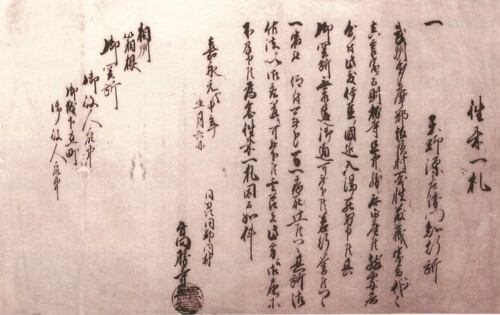
Travel Permit for Bathing in Izu (Takahashi Family Documents 291)
This document is a travel permit issued for the purpose of going to the hot springs in Izu for medical treatment. It certifies that Takasho-ji Temple in Sakahama Village is the family temple of the holder and issues a "Travel Pass" to request passage permission at Hakone Checkpoint and other locations, thereby providing identity assurance. This document was created in the first year of Kaei (1848), and it appears that during the late Edo period in the Tama region, it was common to travel to hot spring resorts such as Izu and Hakone for recuperation.
Reference Bibliography: "Ancient Documents of Inagi City (II)", "Inagi City History Volume I", "Inagi City Historical Materials Volume 2"


This page is managed by the Lifelong Learning Division, Department of Education
Inagi City Local History Museum
1-9-1 Hirao, Inagi City, Tokyo 206-0823
Phone number: 042-331-0660 Fax number: 042-331-0660
Inquiries to the Lifelong Learning Division, Department of Education, Inagi City