


Artifacts Excavated from the Inagi Shitate Site


Tateidai Ruins of Inagi City
On the plateau spreading southeast of the Tate Shrine in Momura, there was the Tateidai Ruins of Inagi City. Excavations were conducted from 1991 to 1993, revealing that the site mainly dates to the Jomon period and the Nara and Heian periods. The discovered remains include five pit dwellings and 310 hunting pitfall holes from the Jomon period, and 78 pit dwellings, 41 posthole buildings, and five pit structures for pottery firing from the Nara and Heian periods. Particularly valuable remains are the dwelling sites and posthole buildings from the Nara and Heian periods, which were intermittently occupied from the 8th to the 11th century.
A large number of artifacts such as earthenware, stone tools, and ironware were excavated from these ruins, and 123 particularly important items have been designated as Tangible Cultural Properties of Inagi City.
Jomon Period Materials
Jomon Period materials consist of pottery from the Early and Middle periods, excavated from the remains of pit dwellings. There is one deep bowl-shaped pottery piece from the Early Jomon period, two deep bowl-shaped pottery pieces from the Middle Jomon period, and one pedestal from the Middle Jomon period. One pottery piece from the Early period and one from the Middle period are believed to have been used for cooking. Additionally, one remaining pottery piece from the Middle period was used as a hearth inside the dwelling. The pedestal, measuring 9.7 centimeters in height and 15 centimeters in diameter, was used as a stand for placing objects, but it is a very rare find among excavated materials.
Materials from the Nara and Heian Periods
A total of 119 items from the Nara and Heian periods include 67 earthenware and Sue ware, 6 green glazed pottery and ash glazed pottery, 34 iron tools, and 12 other items.
Haji Ware and Sue Ware
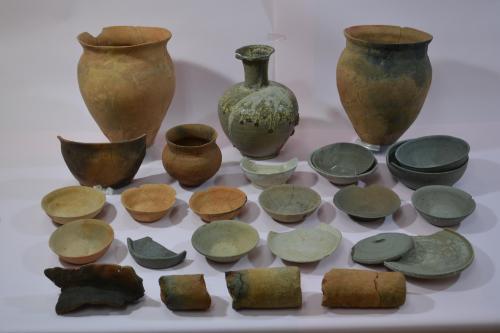
Haji ware is a brownish earthenware that inherits the tradition of Yayoi pottery and was fired at low temperatures. The materials include long-bodied jars, cup-shaped earthenware, steaming pots, pedestal jars, bowl-shaped earthenware, and kettle pots, totaling 23 items. Sue ware is a gray pottery formed on a potter’s wheel and fired at high temperatures using an anagama kiln, a technique introduced from the Korean Peninsula. The materials include cup-shaped earthenware, plates with foot rings, bowl-shaped earthenware, lids, and others, totaling 44 items. These Haji and Sue wares were everyday tools used for cooking and tableware in daily life.
Ash Glazed Pottery and Green Glazed Pottery
Ash-glazed pottery is pottery that has been coated with a glaze made from plant ash, such as straw, and is of slightly higher quality than everyday tableware. Green-glazed pottery is pottery that uses a glaze containing lead, resulting in a yellow-green color. Unlike everyday tools, these were of high quality and were used for ceremonial purposes. Both types of pottery are rare finds and are valuable materials. As materials, there are a total of six items, including a bowl of green-glazed pottery, a bowl of ash-glazed pottery, a plate with a foot, and a long-necked bottle.
Iron Tools
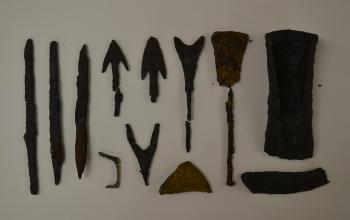
During the Nara and Heian periods, iron tools became widespread as weapons, farming implements, and household tools. Numerous iron tools used at the time were discovered within the remains of pit dwellings. The materials include iron arrowheads, iron sickles, iron axes, iron knives, iron chisels, clamps, iron nails, and iron spindle whorls.
Other Materials
There are sharpening stones for iron tools, stone spindle whorls, and clay weights used as fishing gear.
This page is managed by the Lifelong Learning Division, Department of Education
Inagi City Local History Museum
1-9-1 Hirao, Inagi City, Tokyo 206-0823
Phone number: 042-331-0660 Fax number: 042-331-0660
Inquiries to the Lifelong Learning Division, Department of Education, Inagi City