


Please regularly clean the rainwater infiltration facilities!


In Inagi City, we are promoting the development of rainwater storage and infiltration facilities to manage the rain that falls within the city.
This rainwater retention and infiltration facility can be installed on your property.
By installing rainwater storage and infiltration facilities, the amount of rainwater flowing into waterways and rivers in the city will decrease, helping to prevent flooding.
We ask for your cooperation in the installation and management to protect your homes and the city from frequent localized heavy rain and flooding.
Note: There are areas where rainwater infiltration facilities cannot be installed, so please contact the Sewerage Division when considering new installations.
Facilities for Infiltrating Rainwater
Examples of rainwater infiltration include rainwater infiltration pits and infiltration trenches.
By allowing rainwater to permeate underground, it becomes groundwater and can be effectively utilized as a healthy water circulation resource.
Rainwater infiltration pit
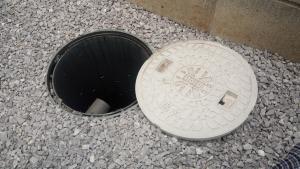
Rain that falls on the roof is directed to the rainwater infiltration basin through gutters and other means.
A rainwater infiltration basin with a diameter of 25 centimeters has the capacity to infiltrate approximately one bathtub's worth of rainwater into the ground per hour.
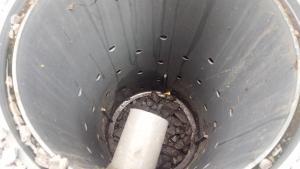
Rainwater infiltration tanks allow rainwater to permeate through the holes in the bottom and sides, as shown in the photo below. Please clean them regularly to ensure that the infiltration function is not compromised by sediment or fallen leaves.
Infiltration Trench
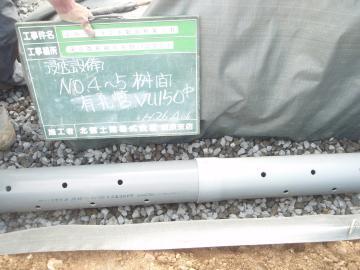
In addition to rainwater infiltration basins, further infiltration effects can be achieved by installing infiltration trenches.
Although it cannot be seen in daily life, it can be constructed on the premises as shown in the photo below. Rainwater permeates through the perforated pipe and the gravel at the bottom.
Rainwater Storage Facility
As an example of rainwater storage, there are storage tanks. By installing a storage tank, rainwater that falls on roofs and other surfaces can be temporarily stored and used as valuable water for home gardens, watering trees, and during disasters.
Additionally, during heavy localized rainfall, it is possible to store rainwater and then release it gradually to prevent concentrated drainage.
Preparation for Flooding
Maintenance and Management of Rainwater Infiltration and Storage Facilities
By properly maintaining and managing rainwater storage and infiltration facilities, their capacity can be fully utilized continuously.
Please regularly clean the sand and fallen leaves that have accumulated in the rainwater infiltration pits and storage tanks.
Additionally, because the rainwater retention and infiltration facilities are buried underground, their location, scale, and maintenance may not be sufficiently confirmed as they are not usually visible.
Please check your home rainwater storage and infiltration facilities and perform regular maintenance.
Rainwater Management Enhancement Month
In Tokyo, June is designated as Rainwater Management Enhancement Month every year, and we ask everyone to prepare for flooding.
If you put garbage or other items into the "stormwater drains" or "ditches" installed within residential areas or along the roads, rainwater will not flow in, increasing the risk of flooding.
Regularly clean around the "rainwater drains" and "ditches" to ensure that rainwater flows smoothly.

Provision of Rainfall Information
The Tokyo Metropolitan Sewerage Bureau provides real-time updates on rainfall information through "Tokyo Amessh" available on the internet.
When heavy rain is expected, let's check the news and information such as "Tokyo Amess" to prepare.
This page is managed by the Urban Environment Management Department Sewerage Division
2111 Higashi-Naganuma, Inagi City, Tokyo 206-8601
Phone number: 042-378-2111 Fax number: 042-378-9719
Contact Us for the Sewerage Division, Urban Environment Management Department, Inagi City