

The damage caused by the Red Palm Weevil is expanding!


The damage caused by the invasive species, the red-banded longhorn beetle, is expanding nationwide, and damage has also occurred in neighboring cities. We ask for your cooperation in prevention measures to stop the spread of this damage.
The Red-Banded Leaf Beetle is an invasive insect that parasitizes Rosaceae trees such as cherry, plum, and peach, with larvae that burrow and damage the wood.
As the damage progresses, the trees will wither, which will have a serious impact on tourism and agriculture, and secondary damage from fallen trees is also anticipated.
The larvae feed inside the trees from April to October, spending 2 to 3 years while excreting a large amount of minced frass (a mixture of larval droppings and wood shavings), and emerge as adults outside the trees around May to August.
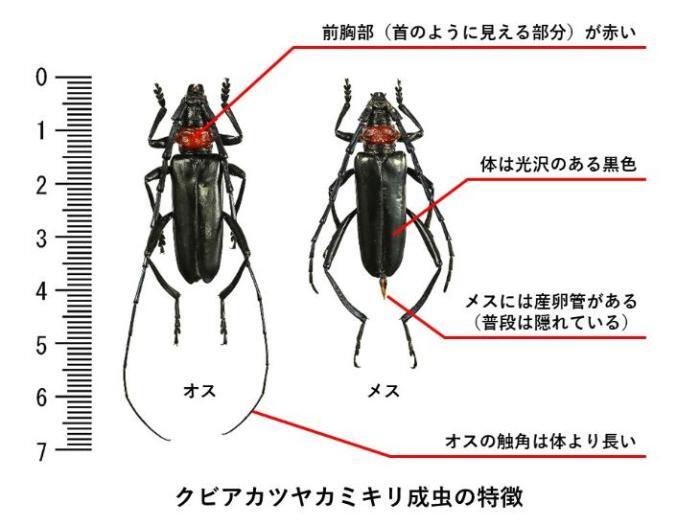
The adult is characterized by a body length of about 2.5 to 4 centimeters, overall glossy black color, and a red thorax (neck).
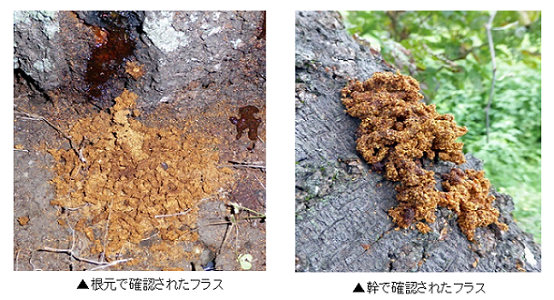
This type of frass is characterized by a large amount of wood chips, and immediately after being discharged, it often connects in rod-like or karinto-like shapes.
The thickness of the larvae varies from about 1mm to 5mm, proportional to the size of the larvae's body.

If you find a red-banded longhorn beetle
If you find an adult red-banded longhorn beetle or traces of damage (frass: a mixture of wood shavings and feces excreted by larvae), please cooperate in extermination by crushing the adult on the spot to prevent the spread of damage, and also provide information to the Environmental Conservation Section of the Living Environment Division.
- Information to provide when reporting
To accurately understand the situation and for expert verification, we would appreciate your cooperation in providing the following information and photos to the extent possible.
1. Date and time of discovery
2. Location of Discovery (address, park name, landmark buildings, etc.)
3. Discovery Details and Tree Species (cherry, plum, peach, etc.)
4. Number of Individuals and Affected Trees (number of adult beetles found, number of affected trees, etc.)
5.Photos and Images (if you can send them by email, etc.)
Note: Close-up (macro) photos of frass (wood chips and feces)
Note: Photos of the locations where frass is extracted (holes in the trunk or base of the tree)
Note: Photos of the entire tree that has been damaged
6. Actual Samples of Frass (Wood Chips and Feces)
Note: Storing and providing samples in a plastic bag or similar greatly helps in species identification.
Please Note (Prohibition on Moving or Keeping Alive)
The red-necked longhorn beetle was designated as a "Specified Invasive Alien Species" on January 15, 2018.
Under the Invasive Alien Species Act, it is strictly prohibited by law to keep or transport them alive.
There is no need to bring adult insects or the like to the service counter. Please either reliably exterminate them on the spot where you find them or cooperate by providing information through photographs.
This page is managed by the Urban Environment Management Department, Living Environment Division
2111 Higashi-Naganuma, Inagi City, Tokyo 206-8601
Phone number: 042-378-2111 Fax number: 042-377-4781
Contact the Living Environment Division, Urban Environment Management Department, Inagi City