


Revision of Sewerage Usage Fee


Basic Policy on the Revision of Sewerage Usage Fees
Sewerage plays a fundamental role in treating wastewater and removing rainwater, supporting our comfortable civic life and socio-economic activities, and contributing to the healthy development of the city. The city plans to review the sewerage usage fees to ensure the stable continuation of Sewerage Operations into the future.
1 Current Status and Issues
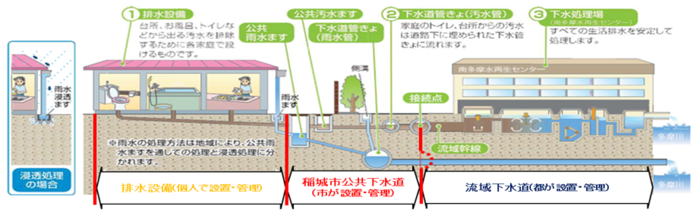
Regarding the city's public sewerage system (wastewater), since there are no wastewater treatment facilities, the wastewater flows into the main trunk line of the Tama River Basin Sewerage, operated by the Tokyo Metropolitan Government, and is finally treated at the Minami-Tama Water Reclamation Center.
Service began in 1985, and as of the end of FY2024, 40 years have passed. The sewerage treatment population coverage rate is over 99.3%, covering almost the entire administrative population.
Going forward, as related projects such as the Land Readjustment Project around Yanokuchi Station and the Tsurukawa Kaido widening project progress, the development of sewage pipelines will advance, and the sewerage treatment population coverage rate is expected to reach 100%.
(1) Current Status of Revenue
While there is a nationwide trend of population decline, the population in this city is slightly increasing due to urban infrastructure development such as the Land Readjustment Project, so sewerage usage fee revenue has remained flat and is expected to continue on this trend.
(2) Current Status of Expenditures
Regarding the expenses for the maintenance and management of the sewer system, a large portion consists of the basin sewer maintenance management charges, which are requested from 30 municipalities to cover part of the maintenance costs of the sewer trunk lines and the water reclamation center managed by the Tokyo Metropolitan Government.
This charge was suddenly and significantly increased in April 2026, and further increases are expected due to rising costs of materials and labor thereafter.
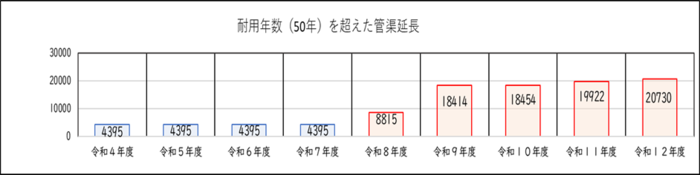
On the other hand, the facilities independently managed by the city mainly consist of pipelines, and an increase in public sewerage maintenance costs, including the renewal of aging pipelines due to deterioration over time, is anticipated.
(3) Management Environment of Sewerage Operations
Starting with the sudden significant increase in the basin sewerage maintenance burden charges implemented in April 2026, an increase in maintenance costs for aging sewage pipelines and others is expected, resulting in an imbalance between revenues and expenditures.
2. Concept of Expenses Subject to Sewerage Usage Fees
Among the costs related to Sewerage Operations, the expenses for stormwater treatment arise from natural phenomena, and since the benefits of its removal are widely shared, these costs are borne by public funds (stormwater public funds and General Fund transfers). On the other hand, the costs for treating sewage discharged by individuals using the sewer system are clearly attributable to the users themselves, so these should be borne privately (sewage private funds and sewerage usage fees) according to the basic principle.
3. Performance and Future Revenue and Expenditure Estimates of Sewerage Operations
The table below compares the public sewerage maintenance and management expenses related to sewage treatment and the basin sewerage maintenance and management burden charges with the sewerage usage fees, assuming the current sewerage usage fees are continued.
It shows the financial results and estimated settlement amounts from FY2022 to FY2025, as well as the budgets and estimated amounts based on the Sewerage Operations Management Strategy from FY2026 to FY2030.
Performance and Projection Table
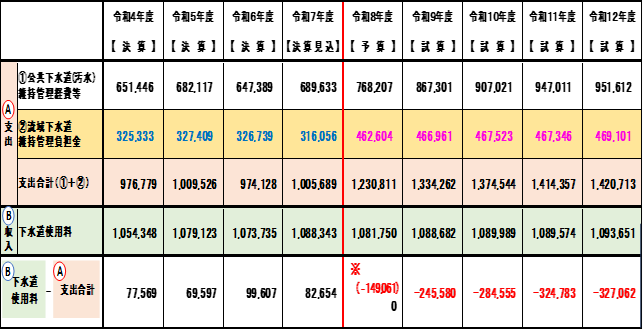
Note: From FY2026, subsidies are provided from the General Fund and others.
Consideration
From FY2026, the balance of income and expenditure will collapse, resulting in a deficit.
This is due to the increase in basin sewerage maintenance burden charges, the soaring costs related to fee collection caused by rising personnel expenses, as well as the increase in maintenance costs due to higher renewal expenses and inflation.
Reference: Length of pipelines exceeding the useful life of 50 years
4 Basic Policy for the Current Sewerage Usage Fee Revision
Regarding expenses related to sewage treatment, it is principle to cover all costs through sewerage usage fees based on the principle of independent accounting. However, considering social conditions such as rising prices, the policy for this sewerage usage fee revision is set as follows from the perspective of balancing sustainable sewerage management and suppressing the burden on residents.
(1) Expenses Subject to the Usage Fee Revision
Regarding the increased maintenance and management costs of sewerage (wastewater) due to medium- to long-term facility renewals, further consideration will be given and revisions will be made at an appropriate time.
This revision targets only the increased costs related to the basin sewerage maintenance burden charges and the collection of sewerage usage fees, and the revised amount will be calculated accordingly.
(2) Gradual Revision
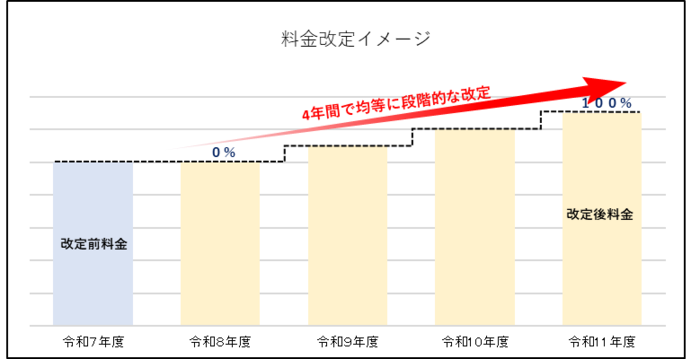
To avoid a sudden increase in burden, the usage fees will be revised gradually over four years from FY2026 to FY2029.
However, the revision rate for FY2026 is set at 0%.
(3) Burden from the General Fund
The burden from the General Fund has already been implemented since FY2026, but any shortfall arising from the gradual revision of sewerage usage fees will be temporarily supplemented by the General Fund.
5 Schedule
|
Timing |
Contents |
|---|---|
| September, 2026 | Submission of the ordinance amendment proposal to the 3rd Regular Session of the Inagi City Council |
|
October, 2026 Until March, 2027 |
Public awareness and publicity activities
|
| April, 2027 | Application of New Usage Fees (Scheduled) |
We will continue to ensure the safety of sewerage facilities so that you can use the sewer system, an essential lifeline for your daily life, stably into the future, while also striving to reduce costs going forward.
Amid significant price increases and the burden felt by citizens, we must impose additional charges, but we kindly ask for your understanding and cooperation.
This page is managed by the Urban Environment Management Department Sewerage Division
2111 Higashi-Naganuma, Inagi City, Tokyo 206-8601
Phone number: 042-378-2111 Fax number: 042-378-9719
Contact Us for the Sewerage Division, Urban Environment Management Department, Inagi City